Last updated 2026-08-19
TL;DR
Arkansas does not issue a standalone irrigation contractor license. You need a state contractor license once one job's labor and materials hit $50,000. Most yard systems never get there. Form an LLC, pull a free EIN, register your tax accounts, follow plumbing and well rules on the water connection, and confirm every current fee with the board that issues it.
Do you need a license for irrigation contractor work in Arkansas?
Arkansas does not issue a standalone irrigation contractor license. You need an Arkansas Contractors Licensing Board license when one job's labor and materials hit $50,000. Most residential sprinkler installs never reach that number. You still need a legal business, tax accounts, and often a plumber or well credential for the wet connection.
That fact trips people who moved from Texas or New Jersey, where the state licenses irrigators by name. Arkansas does not. The state treats you as a contractor if the job is big enough, as a plumber if you tap potable piping, or as a water well contractor if you drill or set pumps. A $6,000 backyard spray system is usually none of those state cards.
Read that before you pay for a prep course that assumes a state irrigator exam. There is not one here.
Local governments still stop jobs. Little Rock, Fayetteville, Fort Smith, Jonesboro, and smaller towns run their own business licenses and trade permits. A city inspector can shut you down for a missing plumbing permit even when the Contractors Licensing Board would never look at your truck.
House building is a different license family (residential building contractor). Sprinkler laterals in a lawn are not a house. Do not buy a residential building card just because the word residential appears on a form. If you are the prime on a full-home build that happens to include irrigation, ask the board how they want that bid classified. Guessing is how you buy the wrong application.
The longer license map, including what ACLB actually issues, is in irrigation contractor license in Arkansas.
What does the Arkansas $50,000 contractor threshold actually cover?
It is a per-job cost trigger, not a yearly sales trigger. Arkansas law defines a contractor as a person or firm that bids or performs construction or a similar improvement "when the cost of the work to be done, or done, in the State of Arkansas by the contractor, including, but not limited to, labor and materials, is fifty thousand dollars ($50,000) or more." That clause is Ark. Code § 17-25-101. [1]
One $52,000 sports-field job needs the license. Twenty $4,000 residential systems in the same month do not add together under that definition. People mix this up with sales tax, which does care about volume.
Materials you furnish count. Cheap labor and expensive mainline still count. If a general contractor hires you and your subcontract is $50,000 or more, you are inside the statute. Arkansas law treats you as a contractor once a job's labor and materials hit $50,000 (Ark. Code § 17-25-101).
If you do apply, ACLB also assigns a license "amount." That amount is the maximum you may bid. Financial statement rules scale with it. I would not guess the current working-capital chart or the exam outline. Pull both from the board before you pay a CPA for a reviewed statement you do not need yet.
Public work adds bonds and bid forms. Private residential spray work almost never does. If you later chase municipal parks or golf, budget calendar time for the contractor packet. Confirm every fee with ACLB. Packets change.
Alabama uses a different contractor structure if you work both sides of the river. Start with how to start an irrigation contractor in Alabama.
How much does it cost to start an irrigation contractor in Arkansas?
Plan on a few hundred dollars of state paper if you stay under the contractor threshold, and several thousand once you add insurance, a used trailer, and a trencher. The Secretary of State's published domestic LLC articles fee has been $45. Confirm the number on the forms and fees page before you file, because fee lists get revised. [3] An IRS EIN is $0 if you apply on IRS.gov. [4]
The charter is not the expensive part. A walk-behind trencher or vibratory plow, a work trailer, a decent truck, fittings stock, and a locator will dwarf the LLC receipt. I will not invent a starter-kit total. Used iron in the Delta trades at whatever the last farm sale brought.
General liability is not optional if you cut a gas line or flood a crawlspace. Shop quotes. Premiums move with limits, claims, and whether you pull wells. Anybody posting one premium for every irrigation contractor in Arkansas is guessing.
Skip a commercial contractor license until you have a bid that needs it. That application can require a financial statement. That is a real CPA invoice. Wasteful if your biggest job is $8,500.
Arkansas state sales tax is 6.5 percent, and cities stack local rates on top. [5] How you report materials versus labor is a Department of Finance and Administration question. Get it straight in month one.
Workers' compensation becomes a statutory issue once you regularly employ three people. [6] One helper and you may still want a policy because homeowners and GCs will ask for a certificate.
City privilege licenses are separate and local. Confirm the current amount with the clerk where you hang your hat.
| Paper item | What you should expect | Who sets it |
|---|---|---|
| Domestic LLC articles | $45 on the published SOS fee list (reconfirm) | Arkansas Secretary of State [3] |
| IRS EIN | $0 on IRS.gov | Internal Revenue Service [4] |
| Sales and use tax permit | Confirm current registration rules | Arkansas DFA [5] |
| State contractor license | Only if a job hits $50,000; fees vary by packet | Contractors Licensing Board [1] |
| Workers' comp | Required at 3 employees; buy earlier if bids demand it | AWCC / Ark. Code § 11-9-102 [6] |
| City business license | Varies by town | City clerk |
How long does it take to start an irrigation contractor in Arkansas?
You can be legally open for small private jobs in a short stretch if you only need an LLC, an EIN, a DFA tax account, and a city license. Online SOS filing and the IRS EIN application often come back fast. I will not quote a processing clock. Those queues move. Confirm current turnaround with each office. Nobody should promise you a start date the board has not put in writing.
A Contractors Licensing Board application is a different project. Financial statements, experience affidavits, and any exam the board assigns all add calendar time. There is no honest public guarantee. Ask ACLB for the current packet and do not promise a customer a large-job bid date you cannot meet.
Plumbing or water well credentials, if you need them, take longer than a city privilege license. Schooling, apprenticeship hours, and exam seats sit on those paths. They are careers, not afternoon errands.
Build the first-year calendar around the slowest credential you actually need, not the LLC email. If you only install residential laterals and subcontract the potable tap, you are waiting on SOS, IRS, DFA, insurance, and the city. That is a much shorter list than well driller plus commercial contractor.
Do you need a plumber's license to install irrigation in Arkansas?
Often you need a licensed plumber for the potable tap and the backflow assembly, even when you do not need a contractor license. Arkansas licenses master and journeyman plumbers through the Department of Health plumbing program. [7] Tying a sprinkler point of connection into drinking water is plumbing.
I would not install or certify a backflow preventer unless I held the plumbing or tester credential that city wants. Inspectors in the larger towns care about this. A failed RPZ floods a mechanical room. That is how small firms get sued.
The laterals, heads, valves, and controller on the customer side of an approved backflow device are the part most irrigation-only crews actually run. Some cities still want the whole system on a plumbing permit. Ask before you trench. Get the answer in writing if the counter is vague.
Do not let a supply house talk you into teeing off the meter because "everybody does." That is how you meet the health department the hard way.
If you want the plumbing license itself, that is years of apprenticeship, not a weekend class. Subcontract the tap in year one. Keep the irrigation work. That is what I would do until the tap volume justifies a plumber on payroll.
What if the job is a well, a pump, or farm irrigation?
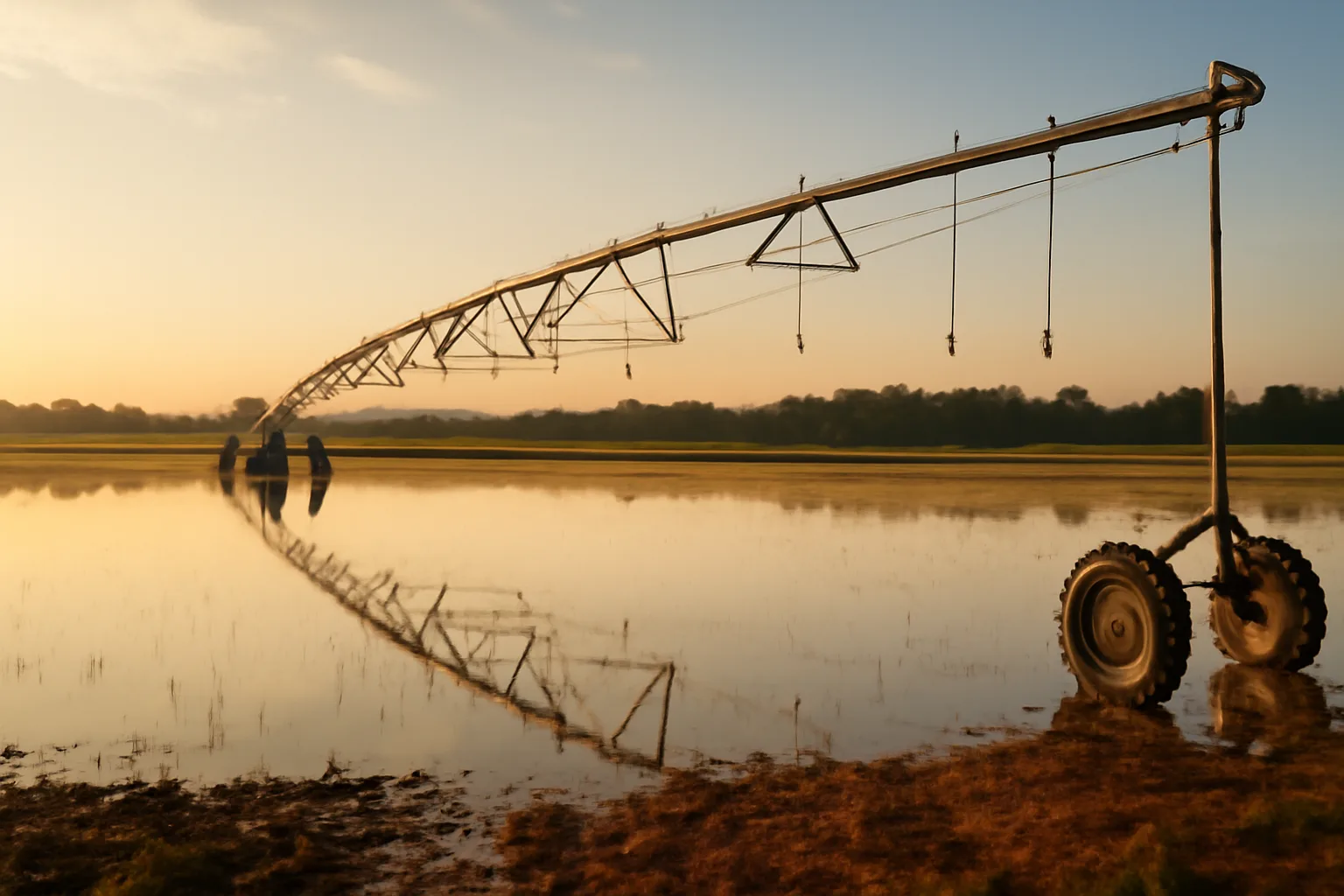
Farm irrigation is a different trade. Rice, soybeans, and corn in the Delta run on wells, surface water, and center pivots. USDA irrigation surveys have ranked Arkansas among the states with the most irrigated acres. [12] That work is not a backyard zone valve.
Constructing a water well or installing a pump generally requires a license from the state's water well construction program, now under the Arkansas Department of Agriculture, Natural Resources Division. [8] A landscape sprinkler background does not cover a 12-inch ag well. Do not bid it.
Pivot assembly, land leveling, and on-farm pipeline often sit with farm-service and heavy-equipment shops. Big dollar jobs can still trip the $50,000 contractor rule even when the customer is a farmer. Read § 17-25-101 again before you bid a 160-acre conversion. [1]
University of Arkansas Cooperative Extension publishes irrigation scheduling and water-management material your farm customers already use. [13] Read it so you do not talk like a turf tech in a rice field.
If you only want residential turf, stay out of well drilling. The liability and the license are not beginner projects. The money looks good on a bid board. The bond claim on a collapsed well does not.
How do you register the business with Arkansas and the IRS?
Pick an entity, file it, then get tax numbers. Most small crews file as an Arkansas LLC. Articles of Organization go to the Secretary of State. The fee is on the SOS forms and fees list. The published domestic LLC articles fee has been $45. Confirm it before you pay. [3] [11]
Then get an EIN. The IRS says, "Applying for an EIN is a free service offered by the Internal Revenue Service." Use IRS.gov. Ignore the paid middleman sites that charge you for a free form. [4]
Register with the Arkansas Department of Finance and Administration for a sales and use tax permit if you sell materials or taxable labor. The state rate is 6.5 percent before local add-ons. [5] If you hire people, register with the Division of Workforce Services for unemployment insurance. Confirm current employer registration steps there. Do not invent a due date.
A sole proprietorship with only a DBA is cheaper on day one and messier when a school district wants to pay a company. I would file the LLC. Keep a separate bank account. That is dull advice and it still saves people.
Out-of-state firms adding Arkansas jobs also file as a foreign entity with SOS. Do that before you bid, not after the first invoice bounces.
If you later sit a contractor law exam here, or an irrigator exam in a state that actually tests irrigators, IrrigatorPath publishes a $149 one-time State Irrigator Exam Kit at /start. Arkansas does not run a standalone irrigator test, so do not buy exam prep you cannot use.
What insurance and bonds do Arkansas irrigation contractors actually carry?
Nobody at the statehouse hands you a standard insurance menu. What you carry is what customers, GCs, and landlords demand, plus workers' comp once the statute hits.
General liability is the policy people ask for first. Auto on every truck is next. Equipment coverage matters once you own a trencher worth stealing. I would not start digging without GL and auto. An umbrella can wait until a district asks for a $2 million certificate.
Workers' compensation is required when you regularly employ three or more people. [6] Owner-only shops sometimes skip it and then lose a bid because the GC's wrap will not list you. Buy what the bid docs demand.
Bonds show up on public work and on a few large private jobs. Arkansas public improvement contracts have statutory bonding rules. Confirm the current threshold and form with the awarding agency. Do not invent a bond number on a bid form.
Skip the "bonded and insured" decal until the policies exist. Inspectors and GCs can ask for the dec page the same afternoon.
What local permits and backflow rules show up on real jobs?
Expect a city business license where you are based, plus a trade permit on many installs inside city limits. Larger Arkansas cities publish the license steps on their finance or development pages. Fees are local. Confirm with the clerk. [11]
Right-of-way work (boring under a street, working near a meter in the parkway) can need a public-works permit and a locate. Call 811 before you trench. That is not a courtesy. It is how you avoid a gas line.
Backflow is the inspection item that kills sloppy jobs. The assembly type (PVB, DC, or RP) depends on the hazard and the water purveyor. Testing is periodic. Some utilities keep a tester list. Stay on it or partner with someone who is. The Department of Health plumbing program is the statewide door for the plumbing side of that conversation. [7]
HOA design rules are not statutes. They still stop punch lists. Get controller and valve-box locations on paper before you open the yard.
County work outside any city can be quieter on building permits and louder on wells and septic setbacks. Ask the county planning office once, in writing.
What does first-year operations actually look like?
You sell in late winter, trench in spring, punch lists in June, and run service calls in July when zone 4 dies. Arkansas heat and clay will teach you more than a catalog.
OSHA's excavation rule is the one that bites new trenchers. "Trenches 5 feet (1.5 meters) deep or greater require a protective system unless the excavation is made entirely in stable rock." [9] Commercial mainline can get that deep at the tap. Slope it, shield it, or do not get in it.
Keep as-builts. A simple sketch with valve wires and mainline depths will save the account when you cut your own pipe next season.
WaterSense-labeled controllers and spray bodies are a decent default on municipal water. EPA publishes the professional guidance. [10] They will not get you a license. They will get you fewer callbacks on water bills.
Hire slow. One W-2 helper with a clean driving record beats three casual 1099s you cannot defend. Misclassification is how you meet Workforce Services and the IRS in the same month.
Stock the heads and valves you actually warranty. Do not carry every catalog color. That is a waste of cash in a small shop.
How does Arkansas compare if you also work other states?
Arkansas is lighter on irrigation-specific paper than Texas, California, or New Jersey. Heavier than a pure "no license" story, because $50,000 jobs, plumbing taps, and wells are real.
If you hold a California C-27 or a Texas irrigator license, do not assume it converts. Ask ACLB about contractor reciprocity for large work. Ask the Department of Health about plumbing. Ask the water well program about drillers. Three doors. Three answers.
Neighbor-state walkthroughs worth reading if you chase jobs across a line include irrigation contractor license in Arizona, how to start an irrigation contractor in Arizona, and irrigation contractor license in California. Alabama's contractor path is closer in spirit than California's. See irrigation contractor license in Alabama. Utah's card is a different animal (Irrigation contractor license in Utah).
I would get legal in Arkansas first, then add states. Multi-state endorsements on workers' comp and auto get expensive fast.
What paper should you keep so a board can confirm it later?
Keep the SOS filing, EIN letter, DFA permit, city license, insurance certificates, and any ACLB or well-driller card in one folder. Digital and paper. Boards ask for what they issued. They do not reconstruct your memory.
Save every bid that approached $50,000, even if you lost it. That file is how you decide when the contractor application is no longer optional. [1]
Keep locate tickets, backflow test reports, and as-builts for the life of the warranty plus a few years. When a leak shows up under a patio, those sheets are the company.
Confirm every current fee, form name, and processing time with the office that collects the money. Do not treat a blog date as a board calendar.
IrrigatorPath is an independent publisher, not a law firm and not a service company. We do not file applications and we do not promise approvals. If you want the exam kit for states that actually test irrigators, it lives at /start.
Frequently asked questions
Do you need a license for irrigation contractor in Arkansas?
There is no standalone irrigation contractor license. You need an Arkansas Contractors Licensing Board license when one job's labor and materials hit $50,000 under Ark. Code § 17-25-101. Smaller yard systems usually skip that card. You still need business registration, tax accounts, and often a plumber or well license for the water connection. Confirm edge cases with the board.
How much does irrigation contractor cost in Arkansas?
State paper can stay in the low hundreds if you stay under the contractor threshold. The published SOS domestic LLC fee has been $45 and an EIN is $0. Insurance, a trailer, and a trencher are the real checks. Contractor-license fees apply only if you bid $50,000-plus work. Confirm every current fee with SOS, DFA, ACLB, and your city clerk.
How long does irrigation contractor take in Arkansas?
A small private shop waiting only on an LLC, EIN, tax permit, insurance, and a city license can open in a short stretch, but offices do not publish a guarantee you can take to a customer. An ACLB contractor application, a plumber path, or a well-driller card adds calendar time. Confirm current processing with each board. Do not promise a start date they have not given you.
Is there a state irrigator exam in Arkansas?
No. Arkansas does not run a standalone irrigator license exam. Large construction jobs may involve ACLB trade or law testing if you apply for a contractor license. Plumbing and water-well programs have their own exams. Do not buy irrigator-exam prep unless you also work in a state that actually tests irrigators.
Can I install sprinklers in Arkansas as a sole proprietor?
Yes, if the jobs stay under the $50,000 contractor trigger and you follow tax, city, plumbing, and well rules that apply to the work. A sole prop is cheaper on day one. An LLC is cleaner when a customer wants to pay a company and when a claim shows up. I would file the LLC and keep a separate bank account.
Does a Texas irrigator license work in Arkansas?
Not as a substitute for Arkansas paper. Texas licenses irrigators by name. Arkansas does not. Your Texas card does not replace an ACLB contractor license on a $50,000 job, a plumber on a potable tap, or a water-well license on a pump. Ask each Arkansas board about any reciprocity they actually offer. Do not assume it.
Do I charge sales tax on irrigation installs in Arkansas?
Arkansas state sales tax is 6.5 percent, and cities add local tax. Materials are generally in the tax system. How you report mixed materials and labor depends on DFA contractor rules. Register for a sales and use tax permit if you sell taxable items or labor, then ask DFA how they want irrigation jobs coded. Do not copy another crew's invoices.
Do I need workers' comp with one helper in Arkansas?
The statute requires workers' compensation when you regularly employ three or more people. One helper may not trip that trigger. GCs and some homeowners still demand a certificate, so many two-person shops buy a policy anyway. Confirm coverage questions with the Arkansas Workers' Compensation Commission and your agent.
Who licenses irrigation wells and pumps in Arkansas?
The water well construction program under the Arkansas Department of Agriculture, Natural Resources Division. Constructing a well or installing a pump is not landscape sprinkler work. Bid it only if you hold that license. Large farm conversions can also trip the $50,000 contractor rule. Confirm both doors before you sign a pivot or well contract.
Do I need 811 locates for a backyard irrigation job?
Yes. Call 811 before you trench, even in a backyard. Gas, electric, communications, and water lines sit in places drawings do not show. Right-of-way work near a meter or under a street can also need a city public-works permit. A locate ticket is cheap compared with a cut line.
Can I pull the potable water tap myself?
Usually no, not if you lack a plumber license. The tap and the backflow assembly are plumbing under the Department of Health program. Many cities want a licensed plumber and a permit on that connection. Subcontract the tap in year one unless you already hold the plumbing credential the city will accept.
What contractor classification do I pick at ACLB?
Only apply if you will bid work at or above $50,000. Classification and license amount have to match the work and the maximum bid. ACLB sets those lists and the financial-statement rules. I would not guess a class from a forum post. Call the board, describe the actual jobs, and use the packet they hand you.
Are Irrigation Association certificates required in Arkansas?
No. IA certification is voluntary industry paper. It can help you talk to a golf course or a WaterSense-minded city, but it does not replace an ACLB contractor license, a plumber card, or a well-driller license. Do not spend certification money thinking it is a state license. It is not.
Do I need a license just to repair existing irrigation systems?
Repair-only work on a small residential system usually does not need an ACLB contractor license if the job stays under $50,000. City permits, backflow rules, and plumber requirements can still apply if you open the potable connection. Well and pump repairs sit under the water-well program. When the invoice climbs, reread § 17-25-101.
Sources
- Arkansas Code § 17-25-101 (Definitions, contractor $50,000 threshold): A contractor is defined by bidding or performing work in Arkansas when the cost of labor and materials is $50,000 or more.
- Arkansas Secretary of State, Business & Commercial Services forms and fees: Arkansas SOS publishes current entity filing fees, including domestic LLC articles (commonly listed at $45; confirm before filing).
- Internal Revenue Service, Apply for an Employer Identification Number (EIN) Online: Applying for an EIN is a free service offered by the Internal Revenue Service.
- Arkansas Department of Finance and Administration, Sales and Use Tax: Arkansas state sales and use tax rate is 6.5 percent, with local taxes added by cities and counties.
- Arkansas Code § 11-9-102 (Workers' compensation definitions, employment of three or more): Arkansas workers' compensation coverage is tied to employment in which three or more employees are regularly employed.
- Occupational Safety and Health Administration, Trenching and Excavation Safety: Trenches 5 feet deep or greater require a protective system unless the excavation is made entirely in stable rock.
- U.S. EPA WaterSense, Irrigation Professionals: EPA WaterSense publishes professional guidance and labeled irrigation products for outdoor water efficiency.
- U.S. Small Business Administration, Register your business: New firms register the legal entity with the state and then obtain federal and state tax IDs and local licenses.
- USDA NASS, 2018 Irrigation and Water Management Survey (Farm and Ranch Irrigation Survey): USDA irrigation survey data place Arkansas among the states with the largest irrigated acreage, driven by Delta crop production.
- University of Arkansas System Division of Agriculture Cooperative Extension, Irrigation and water: UA Cooperative Extension publishes Arkansas irrigation and water-management guidance used by farm and landscape audiences.